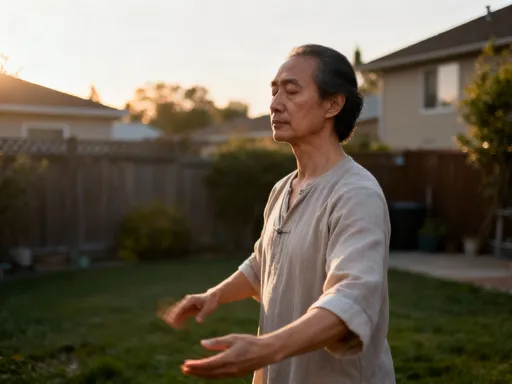
How I Found Calm and Strength Through Qigong—My Real Journey to Daily Vitality
What if just 20 minutes a day could transform your energy, focus, and inner peace? For years, I struggled with low energy and constant stress—until I discovered qigong. Rooted in traditional Chinese wellness, this gentle movement practice helped me reconnect with my body and breath. No hype, no extreme routines—just simple, effective exercises that fit into real life. Here’s how I built a sustainable qigong routine and why it might be the missing piece in your health journey.
The Burnout That Led Me to Qigong
For over a decade, I prided myself on being a high achiever—managing a busy household, working full time, and maintaining what I believed was a healthy lifestyle. I ate balanced meals, walked regularly, and avoided processed foods. Yet, despite all these efforts, I felt increasingly drained. By mid-afternoon, my mind would fog over, my shoulders ached from tension, and I relied on coffee and sheer willpower to push through the day. Sleep didn’t restore me; it merely paused the exhaustion. I wasn’t sick, but I wasn’t truly well either.
I tried everything—intense gym sessions, weekend hikes, even juice cleanses. But the harder I pushed, the more depleted I felt. High-intensity workouts left me sore and wired, not energized. I began to suspect that my definition of health was incomplete. It wasn’t until a friend invited me to a community wellness workshop that I first encountered qigong. The idea of slow, flowing movements felt almost too simple. I remember thinking, How could something so gentle possibly make a difference? Yet, after just one 20-minute session—standing quietly, breathing deeply, moving with intention—I felt a shift. My breath was calmer. My mind was quieter. For the first time in years, I didn’t feel like I was running on empty.
That initial experience sparked curiosity. I wasn’t looking for a miracle, but I was ready to try something different. What began as a skeptical experiment slowly became a lifeline. Unlike other practices that demanded physical effort or rigid schedules, qigong met me where I was—tired, distracted, and in need of balance. It didn’t ask me to do more; it asked me to be more present. And in that presence, I found the first signs of recovery.
What Exactly Is Qigong? (And Why It’s Not Just “Slow Exercise”)
Qigong (pronounced “chee-gong”) is a mind-body practice that combines gentle movement, conscious breathing, and focused intention to cultivate and balance qi—often translated as “life energy” or “vital force.” With roots stretching back thousands of years in traditional Chinese medicine and philosophy, qigong has long been used to support health, prevent illness, and promote longevity. It’s not a religion, nor is it mystical—it’s a practical system grounded in the belief that how we move, breathe, and direct our attention directly influences our physical and emotional well-being.
At its core, qigong is about harmony. It teaches the body to move with ease, the breath to flow without strain, and the mind to settle into awareness. While it may look like slow exercise to an observer, it’s fundamentally different from simply moving slowly. Each motion is intentional, coordinated with the breath, and designed to open energy pathways, release tension, and calm the nervous system. The goal isn’t to burn calories or build muscle, but to restore the body’s natural rhythms and enhance internal resilience.
It’s common to confuse qigong with yoga, tai chi, or meditation, but each has distinct qualities. Yoga often emphasizes physical postures and flexibility, with roots in Indian philosophy. Tai chi is a martial art form that evolved from qigong, involving longer, choreographed sequences. Meditation typically involves stillness and mental focus, often without movement. Qigong bridges these practices—it includes stillness, motion, breathwork, and mindfulness, making it uniquely accessible. You don’t need flexibility, strength, or prior experience. You only need the willingness to begin.
Why Modern Science Is Catching Up to Ancient Wisdom
For many years, qigong was viewed with skepticism in Western medical circles. But as research into mind-body practices has grown, so has the evidence supporting qigong’s benefits. Numerous peer-reviewed studies have shown that regular qigong practice can significantly reduce stress, improve sleep quality, enhance balance, and support cardiovascular health. One meta-analysis published in the Journal of Alternative and Complementary Medicine found that qigong practitioners experienced measurable reductions in cortisol—the primary stress hormone—after just eight weeks of consistent practice.
These benefits are not merely psychological. Slow, rhythmic movements activate the parasympathetic nervous system—the body’s “rest and digest” mode—counteracting the chronic “fight or flight” state many of us live in. When we move with awareness and breathe deeply, our heart rate slows, blood pressure stabilizes, and muscles begin to release stored tension. Over time, this helps retrain the body’s stress response, making it easier to stay calm under pressure.
Breath regulation plays a central role. In qigong, breath is not just a biological function—it’s a tool for healing. Coordinating movement with slow, diaphragmatic breathing increases oxygen flow, improves circulation, and signals safety to the brain. This is why many people report feeling more alert yet deeply relaxed after a session. It’s not about escaping stress; it’s about building a stronger internal foundation so that daily challenges don’t deplete us as easily. Science is now confirming what qigong practitioners have known for centuries: how we breathe directly shapes how we feel.
The 3 Core Principles That Made Qigong Work for Me
When I first started qigong, I approached it like any other fitness routine—focusing on getting the movements “right” and pushing myself to do more. But progress didn’t come from effort; it came from learning to let go. Over time, I discovered three guiding principles that transformed my practice and, ultimately, my well-being.
The first principle is softness over force. Unlike strength training or cardio, qigong doesn’t rely on exertion. Instead, it emphasizes relaxation, fluidity, and minimal effort. At first, this felt counterintuitive. I was used to equating intensity with effectiveness. But I soon realized that gentle, mindful movement creates deeper results. Tension blocks energy flow; softness allows it to move freely. By releasing the need to “work hard,” I began to notice subtle shifts—less stiffness in my joints, greater ease in my posture, and a growing sense of lightness.
The second principle is breath as fuel. In qigong, movement follows the breath, not the other way around. Each inhale lifts, expands, or opens; each exhale grounds, releases, or folds. This synchronization creates a natural rhythm that calms the mind and energizes the body. I learned that without conscious breathing, the movements lose their power. It’s the breath that turns physical motion into a healing practice. When I began to prioritize breath quality—slow, deep, and continuous—I noticed improvements not just during practice, but throughout my day. My breathing became naturally deeper, my reactions less reactive, and my energy more stable.
The third principle is consistency over intensity. One of the most liberating realizations was that I didn’t need long sessions to benefit. Five minutes of mindful practice each day was more effective than an hour once a week. Regularity builds momentum. The body learns to expect and respond to the rhythm of movement and breath. Over time, these small investments compound—like interest in a wellness savings account. I stopped chasing dramatic results and started appreciating gradual progress. And in that shift, I found sustainability.
My Step-by-Step Qigong Routine (Beginner-Friendly & Time-Efficient)
One of the reasons qigong has stayed in my life is its simplicity. I’ve designed a daily routine that fits into real life—no special equipment, no large space, and no time pressure. It’s adaptable, whether you’re at home, in a hotel room, or taking a break at work. Here’s how I structure my day around three short practices.
In the morning, I begin with a 5-minute “Wake-Up Qi” sequence. I stand barefoot on the floor, feet shoulder-width apart, knees slightly bent. I start with deep abdominal breathing—inhaling through the nose, expanding the lower belly, exhaling slowly through the mouth. Then, I raise my arms slowly in front of me, palms up, as if lifting energy from the earth, and bring them overhead, turning palms to face the sky. I lower them gently in front of my body, palms down, visualizing tension releasing. I repeat this 6–8 times, staying focused on the breath. This simple ritual signals to my body that the day has begun with care, not chaos.
By midday, especially if I’ve been sitting at a desk, I do an 8-minute standing flow to reset my focus and circulation. I begin with gentle neck rolls and shoulder circles, releasing stiffness. Then, I shift my weight slowly from side to side, allowing my arms to swing loosely like pendulums. This rocking motion stimulates the kidneys and calms the nervous system. Next, I practice “shaking out”—lightly bouncing on the balls of my feet while letting my arms and hands flutter, which helps release stored tension. I finish with a few rounds of “pushing the ball” in front of my chest—imagining I’m holding a large, soft ball and slowly compressing and expanding it with my palms. This movement coordinates breath and motion, bringing me back into my body and away from mental clutter.
In the evening, I wind down with a 7-minute grounding routine. I stand with feet rooted, knees soft, and hands resting on my lower abdomen. I breathe deeply into my belly, imagining roots growing from my feet into the earth. Then, I slowly rock forward and back, keeping my spine long, to release lower back tension. I finish with “hugging the tree”—standing in a relaxed stance, arms rounded in front as if embracing a large trunk, breathing slowly and steadily. This practice helps me transition from activity to rest, making it easier to fall asleep and stay asleep. Over time, this nightly ritual has become a signal to my nervous system that it’s safe to relax.
Common Mistakes (And How I Learned From Them)
Like anyone new to a practice, I made my share of mistakes. The first was overcomplicating the forms. I watched videos online and tried to memorize complex sequences, believing that more intricate movements meant better results. But I quickly realized that precision wasn’t the point. Qigong isn’t about performance; it’s about presence. When I shifted my focus from “doing it right” to simply moving with awareness, the practice became more nourishing and less stressful.
Another mistake was skipping the breath. There were days when I went through the motions without syncing them to my breathing—just moving my arms while thinking about my to-do list. Unsurprisingly, I didn’t feel any different afterward. I learned that breath is the bridge between body and mind. Without it, qigong becomes empty motion. Now, if I notice my breath is shallow or disconnected, I pause and reset. I take a few deep breaths before continuing, reestablishing the connection.
The most persistent challenge was impatience. I wanted to feel transformed after a week. When that didn’t happen, I doubted the practice. But qigong works gradually, like tending a garden. You don’t see the roots growing, but over time, the plant thrives. I had to let go of the need for immediate results and learn to appreciate small signs—a deeper breath, a moment of calm, less shoulder tension. These subtle shifts are the real markers of progress. Once I embraced this mindset, my relationship with the practice deepened, and so did the benefits.
How to Make Qigong a Lifelong Habit (Without Willpower Battles)
Sustaining any wellness practice requires more than motivation—it requires strategy. I’ve found that willpower fades, but systems endure. The key to making qigong a lifelong habit has been integrating it into my existing routines, not treating it as an extra task.
I anchor my practice to daily habits I already do without thinking. For example, I do my morning sequence right after brushing my teeth. Since that’s a non-negotiable part of my routine, it creates a natural trigger. I’ve also created a small, inviting space in my living room—just enough room to stand, with a soft mat and a candle. This dedicated corner serves as a visual cue, making it easier to begin. I keep my phone on silent and play soft instrumental music, signaling to my brain that this is a time for stillness.
Reminders help too. I set a gentle alarm labeled “Breathe” in the afternoon, which prompts my midday reset. I don’t always do the full routine, but even two minutes of conscious breathing can shift my state. Over time, these small actions have become automatic. I no longer have to “decide” to practice—I just do it, like washing my hands or drinking water.
Finally, I track subtle wins. Instead of measuring success by how long I practiced, I notice how I feel. Did I breathe more deeply today? Was I less reactive in a stressful moment? Did I sleep better? These quiet victories reinforce the value of the practice and make it self-sustaining. Qigong isn’t something I do to fix myself—it’s a daily act of listening, honoring, and caring for the body I live in.
Final Thoughts: More Than Exercise—A Daily Act of Self-Respect
Qigong has become far more than a wellness trend or fitness routine. It’s a practice of presence, a daily reminder that I am worth caring for—not because I’ve earned it through productivity, but simply because I exist. In a world that glorifies busyness and constant output, taking 20 minutes to move slowly and breathe deeply feels like a quiet rebellion. It’s a way of reclaiming time, attention, and energy for myself.
This practice has reshaped my relationship with health. I no longer see it as a list of things to fix or optimize. Instead, I see it as a continuous process of listening and responding—with kindness, not criticism. Qigong has taught me that strength isn’t always loud or forceful; sometimes, it’s the courage to stand still, breathe deeply, and trust that healing is happening, even when I can’t see it.
If you’re feeling drained, overwhelmed, or disconnected, I invite you to start small. Try one five-minute sequence. Focus on your breath. Notice what shifts. Stay curious. There’s no need to believe in energy or ancient traditions to benefit—just an openness to feel what’s already within you. And remember, as with any new wellness practice, it’s wise to consult your healthcare provider, especially if you have underlying health conditions. This isn’t a substitute for medical care, but it can be a powerful complement. Your journey to vitality doesn’t have to be complicated. Sometimes, it begins with a single breath.